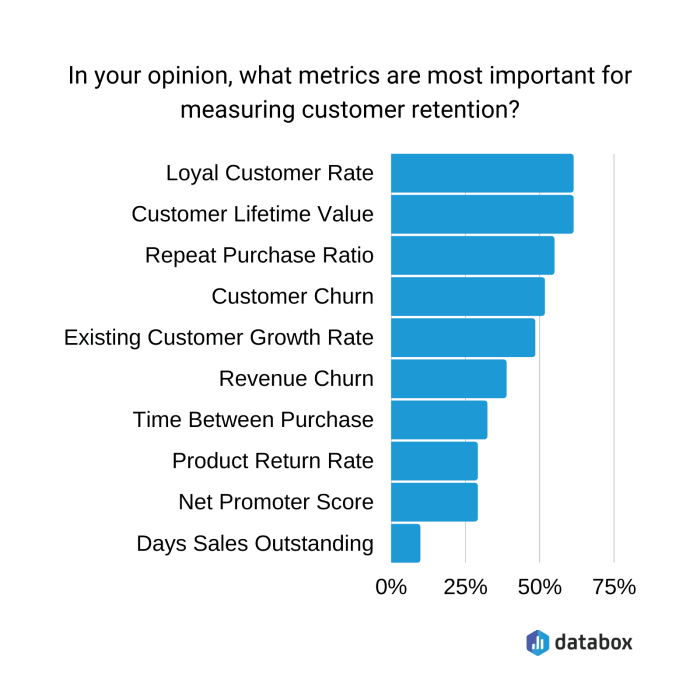
Understanding your customer base is paramount to business success. This guide delves into the crucial world of customer retention metrics and KPIs, providing a framework for analyzing customer behavior, identifying churn risks, and ultimately boosting your bottom line. We’ll explore various metrics, from financial indicators to customer satisfaction scores, and show how they work together to paint a complete picture of your customer journey.
By mastering these metrics, you can proactively identify at-risk customers, refine your customer service strategies, and optimize your retention efforts for maximum impact. This isn’t just about tracking numbers; it’s about understanding the “why” behind the data and using that understanding to build stronger, more profitable relationships with your customers.
Analyzing Customer Churn
Understanding and mitigating customer churn is crucial for sustained business growth. By proactively identifying at-risk customers and implementing targeted retention strategies, companies can significantly improve profitability and build stronger customer relationships. This section will delve into the process of analyzing customer churn, from identifying at-risk segments to reporting key findings.
Identifying and Segmenting At-Risk Customers
Effective churn prediction requires a systematic approach to identifying and segmenting customers likely to churn. Understanding the characteristics and behaviors of these customers allows for the development of targeted retention strategies.
- Analyze Customer Demographics: Examine age, location, income level, and other demographic data to identify patterns associated with higher churn rates. For example, customers in a specific geographic region might consistently exhibit higher churn due to factors like competitor presence or service limitations.
- Track Customer Behavior: Monitor usage patterns, website activity, customer service interactions, and purchase history. Decreased engagement, negative feedback, or a lack of recent purchases can indicate a higher risk of churn. For instance, a significant drop in monthly logins to a software platform could be a strong predictor of churn.
- Employ Customer Segmentation: Group customers based on shared characteristics and behaviors. This allows for the development of tailored retention strategies for each segment. For example, segmenting customers into “high-value,” “medium-value,” and “low-value” groups can inform resource allocation for retention efforts.
- Utilize Customer Lifetime Value (CLTV): Calculate the predicted net profit attributed to the entire future relationship with a customer. Customers with low CLTV may be less profitable to retain, allowing for focused efforts on high-CLTV customers. For example, a customer with a high CLTV might justify more intensive retention efforts, such as personalized outreach or exclusive offers.
- Leverage Predictive Modeling: Employ statistical techniques, such as logistic regression or survival analysis, to build predictive models that identify the probability of churn for individual customers. These models can incorporate various factors to provide a more accurate prediction than individual indicators alone. For instance, a model could combine usage data, customer service interactions, and demographic information to predict churn with a higher degree of accuracy.
Conducting a Churn Analysis
A thorough churn analysis involves a structured process encompassing data collection, analysis techniques, and reporting. This process provides actionable insights for improving customer retention.
Data Collection: Gather relevant data from various sources, including CRM systems, customer support logs, website analytics, and transactional databases. Ensure data quality and consistency to avoid biased results. Data cleaning and preprocessing are crucial steps to handle missing values and outliers.
Analysis Techniques: Employ statistical methods to analyze churn patterns. This may include calculating churn rates, identifying key drivers of churn through regression analysis, and building predictive models using machine learning techniques. Survival analysis is particularly useful for understanding the time until churn.
Reporting: Summarize findings in a clear and concise report, including visualizations to aid understanding. The report should highlight key drivers of churn, at-risk customer segments, and recommendations for improving retention.
Sample Churn Analysis Report
This report summarizes key findings from a churn analysis conducted on a sample customer base.
Executive Summary: The analysis reveals a 15% monthly churn rate, with significant variations across customer segments. Key drivers of churn include poor customer service experiences and lack of product engagement. Targeted interventions are recommended to address these issues.
Churn Rate by Segment: A bar chart displays the churn rate for different customer segments (e.g., high-value, medium-value, low-value). The high-value segment exhibits a lower churn rate (10%) compared to the medium-value (18%) and low-value (25%) segments. The chart visually highlights the disparity in churn rates across segments, emphasizing the need for targeted retention strategies.
Top Drivers of Churn: A Pareto chart illustrates the relative contribution of different factors to churn. Poor customer service accounts for 40% of churn, followed by lack of product engagement (30%) and pricing concerns (20%). The chart clearly demonstrates the most impactful factors, guiding resource allocation for improvement.
Churn Prediction Model: A scatter plot displays the predicted probability of churn against actual churn for a subset of customers. The plot visually represents the accuracy of the predictive model, allowing for assessment of its effectiveness in identifying at-risk customers. The closer the points are to a diagonal line, the more accurate the prediction.
Recommendations: Based on the analysis, the report recommends improving customer service processes, enhancing product onboarding, and offering personalized incentives to retain at-risk customers. These recommendations are directly tied to the identified key drivers of churn and aim to address the root causes.
Improving Customer Lifetime Value (CLTV)
Understanding and maximizing Customer Lifetime Value (CLTV) is paramount for sustainable business growth. A higher CLTV indicates that customers are more valuable over their relationship with your company, leading to increased profitability and a stronger financial foundation. By focusing on strategies to improve CLTV, businesses can effectively reduce customer churn and enhance overall revenue.
CLTV is a prediction of the net profit attributed to the entire future relationship with a customer. Calculating CLTV involves estimating the revenue a customer will generate throughout their engagement with your business, minus the costs associated with acquiring and retaining them. This metric provides invaluable insights into the profitability of different customer segments, informing strategic decisions related to customer acquisition, retention, and resource allocation.
CLTV Calculation Methods
Several methods exist for calculating CLTV, each with its own strengths and weaknesses. Choosing the right method depends on the complexity desired, the data available, and the specific business needs. The accuracy of the CLTV calculation heavily relies on the quality and completeness of the input data.
| Method | Formula | Advantages | Disadvantages |
|---|---|---|---|
| Simple CLTV | Average Purchase Value
|
Easy to understand and calculate; requires minimal data. | Overly simplistic; doesn’t account for customer churn or varying customer behavior over time. Provides a very rough estimate. |
| Transactional CLTV | ∑ (Average Revenue per Transaction
(where n = number of periods in customer lifespan) |
More accurate than Simple CLTV; considers customer retention rate. | Requires more data than Simple CLTV; still doesn’t fully account for variations in customer behavior. |
| Margin-Based CLTV | (Average Purchase Value
|
Accounts for profitability at a transaction level, providing a more refined picture of actual value. | Requires detailed data on gross margins, potentially more challenging to obtain and maintain. |
| Custom/Advanced CLTV Models | Various statistical models (e.g., survival analysis, regression models) are used. | Highly accurate; considers numerous factors influencing CLTV (e.g., customer segmentation, marketing campaigns, seasonality). | Requires significant data, technical expertise, and sophisticated software. Can be computationally intensive. |
Prioritizing Customer Segments Using CLTV
Once CLTV is calculated, it can be used to segment customers based on their predicted lifetime value. This allows businesses to prioritize retention efforts towards high-CLTV customers, maximizing return on investment. For example, a business might offer loyalty programs or personalized services to high-value customers to further increase their CLTV and retention rate. Conversely, customers with low CLTV might be targeted with cost-effective retention strategies or allowed to churn naturally.
This targeted approach ensures efficient allocation of resources, maximizing the overall impact of retention efforts. For instance, a SaaS company might offer premium support and onboarding to its enterprise clients (high CLTV) while offering self-service resources to its smaller, less profitable customers (low CLTV).
The Role of Customer Service in Customer Retention
Exceptional customer service is undeniably linked to higher customer retention rates. A positive customer experience fosters loyalty, encouraging repeat business and positive word-of-mouth referrals. Conversely, poor service can quickly drive customers to competitors, resulting in lost revenue and damaged brand reputation. Investing in and optimizing customer service is therefore a crucial element of any effective customer retention strategy.Customer service significantly impacts customer retention through various interactions and touchpoints throughout the customer journey.
These interactions shape the overall perception of the brand and influence the customer’s decision to remain loyal. The quality of service provided at these crucial moments directly correlates with the likelihood of customer retention.
Key Customer Service Touchpoints Influencing Retention
Effective customer service hinges on several key touchpoints. Addressing these areas with care and efficiency is paramount for building lasting customer relationships and minimizing churn.
- Initial Contact and Onboarding: The first interaction a customer has with a company sets the tone for the entire relationship. A smooth and efficient onboarding process, including clear communication and prompt responses to inquiries, significantly impacts the customer’s initial impression and their likelihood of continued engagement.
- Product/Service Support: Providing readily available and effective support when customers encounter problems with products or services is critical. This includes multiple channels for support (e.g., phone, email, chat), knowledgeable representatives, and efficient resolution times.
- Proactive Communication: Regular communication, such as updates on product improvements, new features, or relevant information, keeps customers engaged and informed. This proactive approach demonstrates that the company values their business and fosters a sense of connection.
- Complaint Resolution: How a company handles customer complaints significantly impacts loyalty. A swift, empathetic, and effective resolution process demonstrates a commitment to customer satisfaction and can even turn a negative experience into a positive one, strengthening the customer relationship.
- Post-Purchase Follow-up: Following up with customers after a purchase to check on their satisfaction and address any concerns demonstrates care and attention. This fosters a sense of loyalty and provides an opportunity to address potential issues before they escalate.
Impact of Swift and Efficient Issue Resolution on Customer Loyalty
Resolving customer issues quickly and efficiently is a cornerstone of building customer loyalty. Customers value their time and appreciate businesses that demonstrate a genuine commitment to addressing their concerns promptly. A delay in resolving a problem can lead to frustration, negative word-of-mouth, and ultimately, customer churn.For example, a study by American Express found that 78% of consumers who have had a positive customer service experience are more likely to recommend that business to others.
Conversely, a negative experience can have a significant detrimental effect. A single negative experience can lead to a 22% drop in customer satisfaction, highlighting the importance of efficient problem resolution. Companies that prioritize swift and effective resolution build trust and demonstrate that they value their customers, fostering long-term loyalty.
Measuring the Effectiveness of Customer Retention Initiatives
Understanding the effectiveness of customer retention strategies is crucial for maximizing ROI and ensuring sustainable business growth. By meticulously tracking key metrics and analyzing performance data, businesses can refine their approaches, optimize resource allocation, and ultimately improve profitability. This section details a framework for measuring the return on investment (ROI) of various customer retention initiatives and Artikels a system for tracking and reporting on key metrics over time.
A Framework for Measuring ROI of Customer Retention Strategies
A robust framework for measuring the ROI of customer retention strategies requires a systematic approach to tracking relevant metrics and calculating the financial impact of each initiative. This involves identifying key performance indicators (KPIs), establishing data collection methods, and developing a formula for calculating ROI. The following table provides a sample framework:
| Initiative | Metrics Tracked | Data Collection Methods | ROI Calculation |
|---|---|---|---|
| Loyalty Program | Customer retention rate, average purchase value, customer lifetime value (CLTV), program participation rate, cost per acquisition (CPA) | CRM data, transactional data, loyalty program enrollment data, surveys | (Increased CLTV – Program Costs) / Program Costs |
| Improved Customer Service | Customer satisfaction (CSAT) scores, Net Promoter Score (NPS), resolution time, customer effort score (CES), repeat purchase rate | Surveys, feedback forms, call center data, CRM data | (Increased revenue from repeat purchases + reduced churn costs)
|
| Personalized Marketing Campaigns | Open rates, click-through rates, conversion rates, customer engagement, return on ad spend (ROAS) | Email marketing platform data, website analytics, CRM data | (Increased revenue from targeted campaigns – Campaign Costs) / Campaign Costs |
| Proactive Customer Support | Number of proactive outreach attempts, customer engagement rate, reduction in churn rate, customer satisfaction scores | CRM data, support ticket data, survey data | (Reduced churn costs + increased customer lifetime value)
|
Tracking and Reporting on Key Customer Retention Metrics
Effective tracking and reporting of customer retention metrics require a centralized system for collecting, analyzing, and visualizing data. This system should allow for real-time monitoring of key KPIs and the generation of regular reports that track performance over time. The system should include dashboards that provide a clear and concise overview of key metrics, allowing for quick identification of trends and areas for improvement.
For example, a dashboard might display graphs showing trends in customer churn rate, customer lifetime value, and customer satisfaction scores over time, segmented by customer segment or marketing channel. Regular reporting, perhaps monthly or quarterly, allows for timely identification of issues and enables proactive adjustments to retention strategies.
Best Practices for Evaluating and Refining Customer Retention Programs
Regular evaluation and refinement of customer retention programs are essential for ensuring their continued effectiveness. This involves analyzing performance data, identifying areas for improvement, and making adjustments to the programs based on the findings. Best practices include:
Analyzing performance data to identify trends and patterns. For example, identifying specific customer segments with high churn rates or low satisfaction scores can help pinpoint areas needing improvement. This could involve analyzing customer feedback from surveys, reviews, and support interactions.
Regularly reviewing and updating the programs to reflect changes in customer behavior and market trends. Customer preferences evolve, and marketing strategies need to adapt to remain effective. This may involve A/B testing different approaches to identify what resonates most with the target audience.
Using A/B testing to compare the effectiveness of different retention strategies. This allows for data-driven decision-making and ensures that resources are allocated to the most effective initiatives. This might involve testing different email subject lines, website layouts, or loyalty program rewards.
Measuring the ROI of each initiative to determine its effectiveness and justify continued investment. This allows for a clear understanding of which programs are delivering the best return on investment, allowing for better allocation of resources.
Continuously seeking customer feedback to identify areas for improvement. This involves gathering data through surveys, feedback forms, and social media monitoring to gain insights into customer needs and preferences.
Effective customer retention isn’t a one-size-fits-all solution; it requires a nuanced understanding of your specific customer base and a commitment to continuous improvement. By leveraging the metrics and strategies Artikeld in this guide, you can build a data-driven approach to customer retention, fostering loyalty, increasing lifetime value, and driving sustainable business growth. Remember, investing in retention is investing in the long-term health and profitability of your business.
FAQ Explained
What’s the difference between a leading and a lagging indicator?
Leading indicators predict future behavior (e.g., customer satisfaction scores), while lagging indicators reflect past performance (e.g., churn rate).
How can I improve my customer service to reduce churn?
Focus on quick response times, personalized communication, proactive problem-solving, and empowering your customer service team to resolve issues effectively.
What are some common pitfalls in measuring customer retention?
Ignoring qualitative data, focusing solely on vanity metrics, and failing to segment your customer base for targeted analysis are common mistakes.
How often should I review my customer retention metrics?
Regularly, ideally monthly or quarterly, to track progress, identify trends, and make necessary adjustments to your strategies.
What if my CLTV calculation is negative?
A negative CLTV suggests your acquisition costs are exceeding the lifetime value of your customers. Review your acquisition strategy and pricing model.