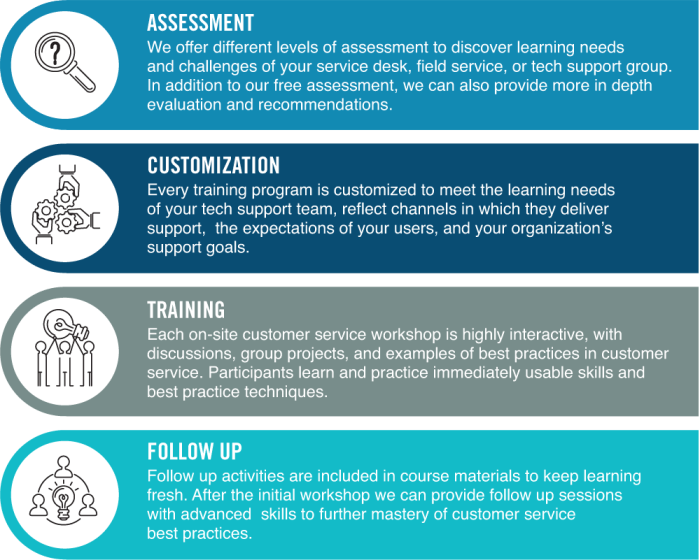
Exceptional customer service is the cornerstone of any successful business. This guide delves into the multifaceted world of customer service training programs, exploring diverse methodologies, effective techniques, and crucial metrics for measuring success. We’ll examine how these programs foster improved customer retention, build stronger relationships, and ultimately drive business growth. From understanding different training models to adapting strategies for various industries, this exploration aims to provide a practical framework for organizations seeking to elevate their customer service capabilities.
We will cover a range of topics, including the advantages and disadvantages of various training delivery methods (online, in-person, blended), the development of effective training modules, and the implementation of strategies to measure the return on investment (ROI) of these programs. We will also explore the crucial role of empathy and active listening in creating lasting customer loyalty and discuss how to adapt training to meet the unique needs of different industries and roles.
Customer Service and Customer Retention

Effective customer service training is paramount for achieving sustainable business growth. It directly impacts customer satisfaction, loyalty, and ultimately, the bottom line. Investing in comprehensive training programs translates to a more engaged and capable workforce, better equipped to handle customer interactions and build lasting relationships.Customer service and customer retention are inextricably linked. High-quality customer service significantly increases the likelihood of retaining customers.
Conversely, poor service experiences often lead to customer churn and loss of revenue. This section explores the vital connection between effective training and improved retention, outlining strategies and examples for building strong customer relationships.
The Correlation Between Effective Customer Service Training and Improved Customer Retention Rates
Companies that invest in robust customer service training programs often experience higher customer retention rates. Well-trained employees are better equipped to handle customer inquiries efficiently, resolve issues effectively, and build rapport. This leads to increased customer satisfaction, which is a key driver of retention. For example, a study by Bain & Company found that increasing customer retention rates by 5% can increase profits by 25% to 95%.
This highlights the significant return on investment (ROI) associated with prioritizing customer service training. Improved efficiency in handling customer issues also reduces operational costs, contributing to increased profitability.
Strategies for Building Strong Customer Relationships Through Exceptional Service
Building strong customer relationships requires a multifaceted approach centered around exceeding customer expectations. Key strategies include: proactive communication, personalized service, efficient problem resolution, and consistent follow-up. Proactive communication, such as sending personalized email updates or offering helpful tips, shows customers that the company values their business. Personalized service, such as remembering customer preferences or addressing them by name, creates a more welcoming and individual experience.
Efficient problem resolution, which includes quick response times and effective solutions, minimizes customer frustration. Consistent follow-up, like sending thank-you notes or checking in after a service interaction, reinforces the company’s commitment to customer satisfaction.
Examples of Successful Customer Retention Initiatives
Many companies have successfully implemented initiatives to improve customer retention. For example, Amazon’s robust customer support system, including easy returns and readily available customer service representatives, contributes significantly to its high customer retention rate. Similarly, companies like Zappos are known for their exceptional customer service, often going above and beyond to resolve issues and build strong customer relationships.
Their dedication to exceeding expectations has cultivated a loyal customer base. These companies demonstrate that investing in customer service pays off in the long run.
The Role of Empathy and Active Listening in Fostering Customer Loyalty
Empathy and active listening are crucial components of exceptional customer service. Empathy allows service representatives to understand and share the feelings of customers, fostering a sense of connection and trust. Active listening involves paying close attention to what the customer is saying, both verbally and nonverbally, ensuring that their concerns are fully understood. This demonstrates respect and validation, leading to increased customer satisfaction and loyalty.
By actively listening and demonstrating empathy, companies can build stronger relationships with their customers and reduce customer churn.
Visual Representation of the Customer Journey and the Impact of Excellent Service
Imagine a flowchart depicting the customer journey. The first stage is “Awareness,” where the customer discovers the company or product. The second stage is “Consideration,” where the customer evaluates options. The third stage is “Decision,” where the customer makes a purchase. The fourth stage is “Experience,” encompassing all post-purchase interactions.
The final stage is “Loyalty,” representing repeat purchases and advocacy. Excellent customer service positively impacts each stage. In “Awareness,” excellent online reviews and word-of-mouth marketing draw customers in. In “Consideration,” clear and helpful information on the website and friendly customer support representatives address questions and concerns. In “Decision,” a smooth and easy purchasing process further builds confidence.
In “Experience,” prompt issue resolution and personalized follow-up solidify satisfaction. Finally, in “Loyalty,” exceptional service fosters a sense of value and encourages repeat business and positive referrals. This visual representation demonstrates how each interaction, shaped by customer service training, contributes to the overall customer journey and retention.
Future Trends in Customer Service Training
The landscape of customer service is rapidly evolving, driven by technological advancements and shifting customer expectations. To remain competitive, businesses must adapt their training programs to equip their agents with the skills and knowledge needed to thrive in this dynamic environment. This section explores the key trends shaping the future of customer service training.
The Impact of Artificial Intelligence and Automation on Customer Service Training
AI and automation are profoundly reshaping customer service, impacting training in several ways. AI-powered tools are increasingly used for tasks like initial customer contact, data analysis, and personalized recommendations. This shift necessitates training programs that focus on how agents can effectively collaborate with AI systems, rather than simply replacing them. For example, training might include modules on interpreting AI-generated insights to personalize customer interactions, or troubleshooting common AI malfunctions.
Furthermore, AI can personalize training itself, adapting to individual learning styles and paces, providing targeted feedback, and identifying knowledge gaps more efficiently than traditional methods. This personalized approach improves learning outcomes and reduces training time.
The Role of Emerging Technologies in Enhancing Training Effectiveness
Virtual Reality (VR) and Augmented Reality (AR) are emerging as powerful tools for immersive and engaging customer service training. VR can simulate realistic customer interactions, allowing trainees to practice handling difficult situations in a safe and controlled environment. For instance, a VR scenario might simulate a frustrated customer complaining about a faulty product. Trainees can practice de-escalation techniques and problem-solving strategies without the risk of negative real-world consequences.
Similarly, AR can overlay digital information onto the real world, providing agents with real-time guidance during customer interactions. Imagine an AR application that displays product specifications or troubleshooting steps directly onto the product a customer is describing. This type of technology significantly enhances knowledge retention and practical application of learned skills.
Future In-Demand Skills and Knowledge for Customer Service Professionals
The future of customer service requires a blend of technical and soft skills. While technical skills like proficiency with CRM software and AI tools remain important, emotional intelligence, adaptability, and problem-solving abilities will be increasingly crucial. Agents will need to effectively manage interactions with customers across multiple channels, including social media, chatbots, and video conferencing. Critical thinking and analytical skills will also be highly valued, enabling agents to quickly analyze customer issues, identify root causes, and offer effective solutions.
Furthermore, the ability to personalize interactions and build rapport with customers will be essential for creating positive customer experiences. Companies like Amazon, known for their sophisticated customer service, already prioritize these skills in their hiring and training processes, reflecting the growing industry trend.
Ultimately, successful customer service training programs are not merely about imparting knowledge; they are about cultivating a culture of exceptional customer service within an organization. By understanding the various approaches, measuring their impact, and adapting strategies to the ever-evolving business landscape, companies can empower their employees to deliver outstanding experiences that foster loyalty, drive retention, and ultimately contribute to sustainable growth.
This guide provides a robust foundation for organizations seeking to build a customer-centric culture and achieve lasting success.
FAQ
What is the average cost of a customer service training program?
Costs vary greatly depending on the program’s length, delivery method, and the number of participants. Expect a wide range, from a few hundred dollars for online courses to thousands for extensive in-person workshops.
How long does it take to see a return on investment (ROI) from customer service training?
The ROI timeframe varies, but many companies see improvements in key metrics like CSAT and resolution times within months of implementing a program. Measuring the long-term impact on customer retention requires ongoing monitoring.
How can I assess the effectiveness of my existing customer service training program?
Utilize a combination of methods: employee feedback surveys, post-training performance evaluations, analysis of key metrics (CSAT, resolution times), and tracking customer retention rates.
What are some common mistakes to avoid when designing a customer service training program?
Common pitfalls include failing to define clear learning objectives, neglecting practical application and role-playing, not providing adequate feedback, and not measuring the program’s effectiveness.


